Two Clocks Inside One Limestone Chamber
Stand just inside the entrance of Fontein Cave and you can watch two clocks run at once. Daylight falls across the left-hand wall, the one every phone camera finds first. A ranger’s torch swings onto the right, and there, at roughly shoulder height, sit the spirals: red-brown, finger-width, pressed into the limestone with a patience nobody has satisfactorily explained. Those lines reached that rock long before Oranjestad had a single stone building on it.
Fontein is a document, not a decoration. The cave sits inside Arikok National Park, in the Santa Cruz district, and it is the one chamber on the island where the human record takes priority over the geological spectacle. The Caquetío (the Arawak-speaking people who lived here when the Spanish arrived, and the ancestors of Aruba’s Indigenous community today) used this space. Saying that plainly carries more weight than any amount of “ancient mystery” framing, and it is where this Fontein Cave history properly begins.
Where the Drawings Actually Sit
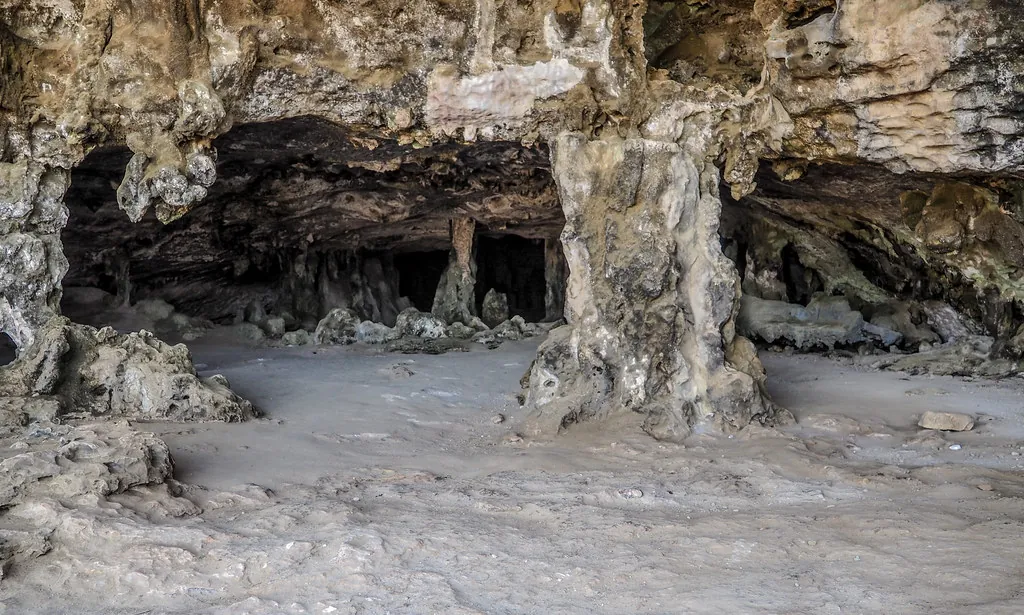
The mouth of the cave is wide, and that detail matters more than most guides admit. Daylight floods the first few metres, so nobody needs a permit or a caver’s nerve to see the Arawak drawings at Fontein Cave. The pigment starts a short walk in, past the point where your eyes have adjusted and the air has dropped a few welcome degrees. You will hear the place before you see much of it: drips landing in the dark, the scuff of shoes on the walkway, a ranger’s voice somewhere behind you.
Easy access cuts both ways. A cave you can stroll into is a cave thousands of people stroll into each year, and the drawings sit at exactly the height a curious hand reaches. Rangers work the chamber in shifts, and the roped path is not decorative. If you want the full etiquette list, the visitor rules page spells it out. What follows here is the history, plus enough geology to make sense of the room you are standing in. Fontein is a dry hillside cave in uplifted limestone, and it has nothing to do with Aruba’s famous cave pool, which is a separate site with a separate story (cave pool closure status).
The Short Version
- Cave type: a dry limestone hillside cave formed in raised marine terraces, not a sea cave and not a volcanic tube.
- Who made the drawings: the Caquetío, an Arawak-speaking Indigenous people, working with fingertips rather than brushes.
- Pigment: red-brown earth tones, and in places a darker paste mixed with bat guano.
- Time depth: the limestone is hundreds of thousands of years old; the drawings are centuries old. The two ages should never be blurred into one sentence.
- Signature sight: root formations, where tree roots from the hillside above have forced through the ceiling and been coated in calcite.
- One rule that matters most: hands off the walls. Skin oil and salt do more damage in a single touch than a decade of damp air.
Clock One: Limestone, Water and Patience
Aruba’s skeleton is Cretaceous. The island rides on the South American continental shelf rather than the volcanic Caribbean arc, which is why it looks so different from its neighbours, and its base rock is the Aruba Lava Formation: basaltic tuff and lava, later intruded by the quartz diorite of the Aruba Batholith somewhere around 85 to 90 million years ago. The limestone arrived much later, laid down in warm shallow water during the Miocene and Pliocene, when this stretch of shelf sat under a sea full of coral and shell.
Rain does the carving. Water falling on the hills above soaks through soil and picks up carbon dioxide on the way down, turning mildly acidic. Where that water finds a joint, a hairline crack in the limestone, it dissolves calcium carbonate grain by grain and the joint widens. Repeat that process across tens of thousands of rainy seasons and a crack becomes a passage. Two phases matter here. Below the old water table, dissolution happens underwater and leaves rounded, smooth-sided conduits. Once tectonic uplift pushes the rock above the water table, the cave drains, air moves in, and decoration begins.
That uplift is why Arikok’s caves cluster along the same line of hills, and why Fontein is dry underfoot instead of tidal. The formations inside have the look of melted candles in an old cathedral, waxen columns leaning into each other, and the ceiling stone in places has the soft grey texture of wet sugar. Calcite grows painfully slowly, often well under a millimetre a decade depending on drip chemistry, which means the larger shapes above your head took longer to build than human beings have existed. Walk past them at tour speed and you will miss the entire first clock.
What You Are Looking At, Formation by Formation
Stalactites and Stalagmites
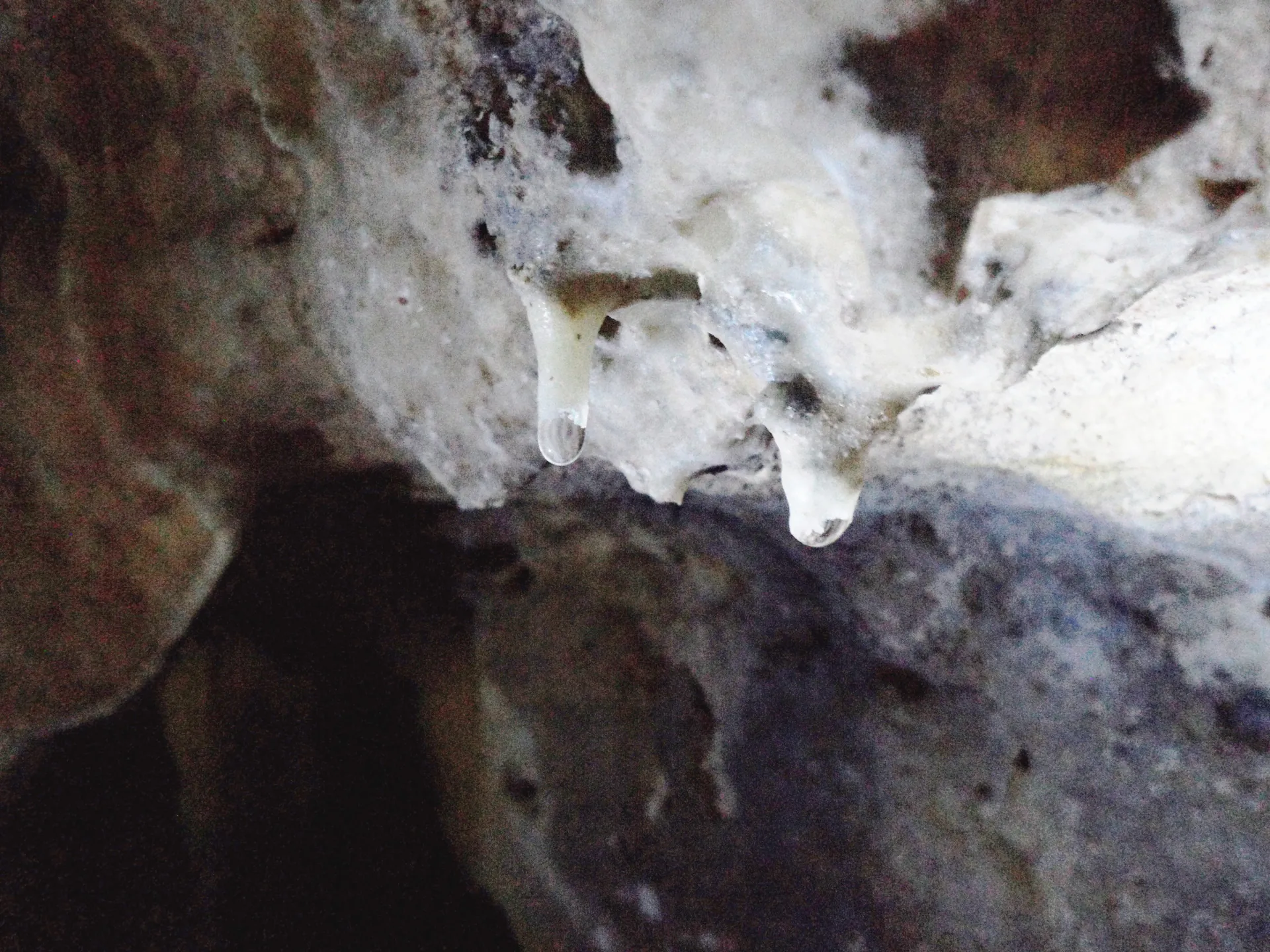
Stalactites hang from the ceiling and grow downward from the drip point; stalagmites rise from the floor where the same drip lands. The tips of both are the youngest calcite in the cave, which is worth remembering when you see how thin some of them are. Those nearest the public path have suffered most, snapped off by shoulders and hands over decades of loose access. Look up at the ceiling and you may spot fossil shell fragments and banding in the rock itself, the sea floor that became a roof.
Root Formations and Columns
Fontein’s own spectacle is vegetal. Trees on the hillside above have pushed roots through cracks in the ceiling, and dripping calcite has coated those roots until they hang as long, pale, tapering curtains, sometimes called rooticicles by the guides who work here. Where a stalactite finally meets the stalagmite growing beneath it, the two fuse into a column. That fusion can take longer than the entire span of written Aruban history, and it happens without anyone watching.
The Two Clocks, Side by Side
| Period | What Was Happening in the Cave | What You Can See Today |
|---|---|---|
| Roughly 200,000 to 100,000 years ago | Coral, shell and sediment compact under shallow sea into limestone. | Fossil shell fragments and banding in the ceiling rock. |
| Roughly 100,000 to 20,000 years ago | Mildly acidic rainwater dissolves joints in the uplifted rock and widens the passages. | The entrance chamber and the low crawl at the rear. |
| Roughly 20,000 to 5,000 years ago | Calcite drips slowly build stalactites, stalagmites and columns. | Melted-candle formations along the rear wall. |
| Roughly 1,000 to 500 years ago | Caquetío communities use the chamber; drawings applied by finger with pigment and guano paste. | Dark geometric motifs across the interior walls. |
| 1800s onward | Guano mining, then early research visitors, then organised tourism. | Soot traces, chisel scars, historic scratched names. |
| Today | Conservation-led access with a roped path and ranger supervision. | Walkway, handrail, and a strict no-touch perimeter. |
Treat those early dates as broad strokes rather than measurements. Radiometric work on Aruban speleothems is thin, and most published ages for the drawings rest on stylistic comparison with similar sites on the Venezuelan mainland rather than direct dating of the pigment itself. The National Archaeological Museum Aruba holds the island’s reference collections and is the honest place to start if you want the current scholarly position rather than a tour-guide summary.
Clock Two: Lines Made by Fingers
Move into the darker part of the chamber and the second clock takes over. The lines here are finger-width, sometimes narrower, drawn rather than sprayed, and the pigment ranges from a warm rust-red to a sooty grey-black where guano paste was used. Many of the shapes are geometric: spirals, concentric curves, and simple grids. Others are anthropomorphic, human figures with arms out, some wearing what look like horned or plumed headdresses. A few appear to have been sketched first and filled in afterwards, which tells you something about how deliberate the work was.
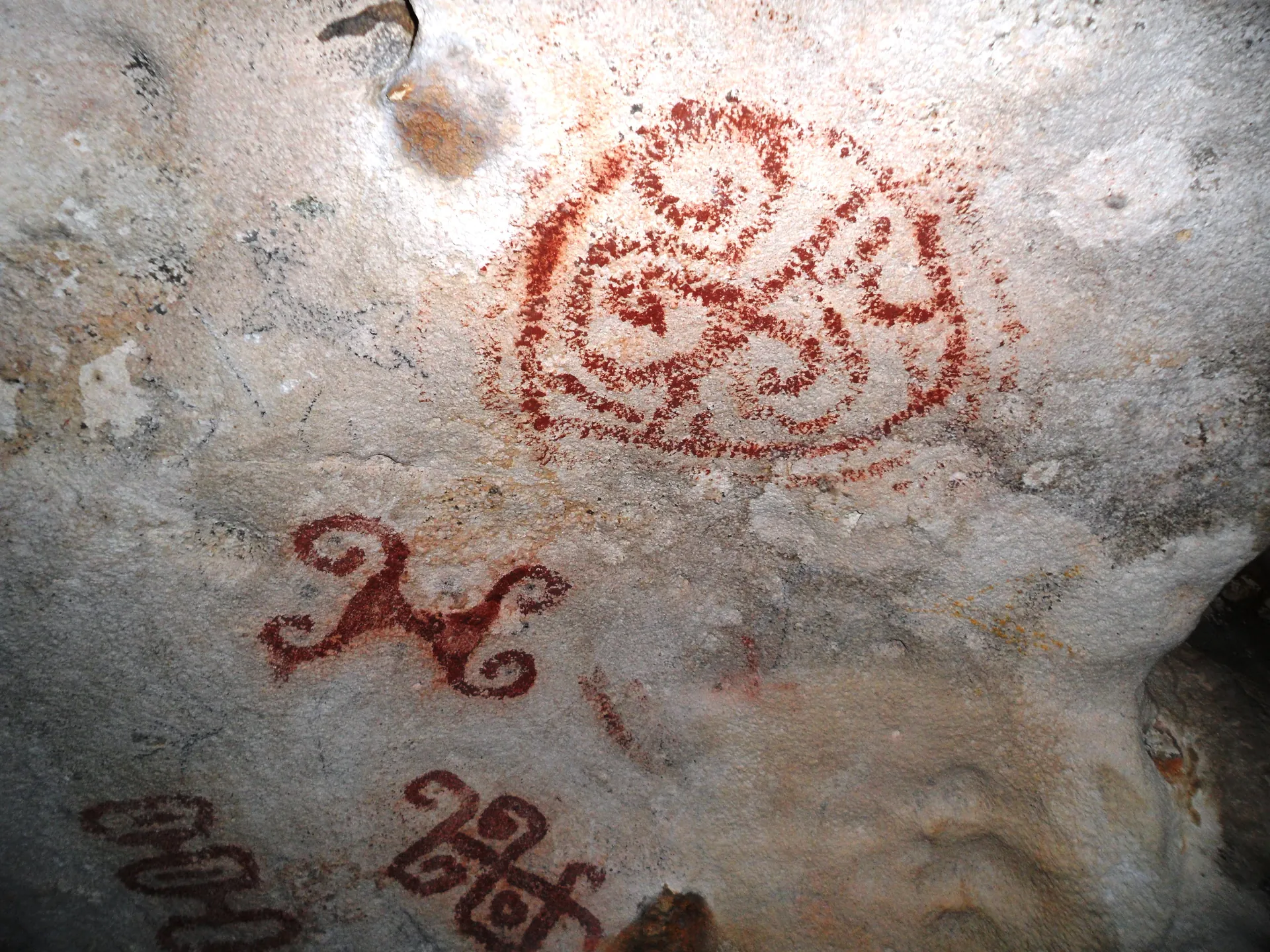
What gets me every time is the scale. These are not grand murals designed for an audience of hundreds. They fit the reach of a standing adult, and some sit where a person would have had to stoop. Whoever made them crouched in a dim, dripping room and worked by touch as much as by sight. The drawings at Fontein are among the most accessible Indigenous rock art in the southern Caribbean, and that accessibility is both the reason they matter to visitors and the reason they are at risk.
These drawings are the oldest surviving handwriting on Aruba, applied by people who paddled here rather than by anyone who arrived carrying a flag.
What the Lines Might Mean, and What Nobody Has Settled
Some of this is agreed. The figures are human and animal forms, the geometry is deliberate, the pigment was applied by finger or with a simple wad of fibre, and the work belongs to the Caquetío cultural world that stretched from the Venezuelan coast through the Lesser Antilles. Aruba sat roughly 25 to 30 kilometres from the Paraguaná peninsula at the narrowest point, close enough for regular canoe crossings, so the island was never a cultural dead end. Its people traded, travelled and intermarried across that water.
The rest is genuinely open. Nobody has settled whether the chamber was ceremonial, residential, a waypoint shelter, or all three at different times. Horned headdresses in Caribbean rock art sometimes point to ritual specialists, sometimes to hunting disguise, and sometimes to nothing more than an artist’s flourish. Spirals appear across the region without a single agreed reading. The park’s interpretation boards and the National Archaeological Museum Aruba present the evidence without pretending the puzzle is closed, which is the right instinct. Anyone who hands you a tidy answer about the meaning of Aruba Fontein Cave rock art is selling something.
Stand still for thirty seconds when the ranger’s torch lands on the drawings. Your eyes adjust, the pigment sharpens, and you stop looking at a photograph and start looking at a decision someone made with a fingertip.
What Time Does to a Cave, and What Visitors Do Faster
Limestone caves are not static after they form. Water keeps moving through them, roots keep probing, and humidity keeps working on every surface. Human presence simply accelerates everything. The chamber has carried scars since the guano-mining years in the 1800s, when workers cut channels and left soot on the walls, and later visitors scratched their names beside petroglyphs that had survived five centuries untouched. Conservation here is mostly a matter of slowing people down.
- Skin contact. Oil and salt from a fingertip etch into pigment and into soft calcite, and the damage is permanent rather than cosmetic.
- Flash photography. Repeated bright light fades organic pigments; where signage restricts it, the restriction exists for a reason.
- Breath and body heat. A crowded chamber pushes humidity and carbon dioxide upward, which shifts the chemistry that decides whether calcite grows or dissolves.
- Snapped formations. The pieces nearest the path break first, and a stalactite that took thousands of years is gone in a second.
- Roots and runoff. Compaction on the hillside above changes how water enters the cave, which changes what grows and what crumbles inside it.
- What does no harm. Looking, sketching in a notebook, standing on the marked route, asking the ranger questions, and leaving the rock exactly as you found it.
If you are building a half-day around the cave, the timing matters as much as the etiquette. Coach groups tend to arrive in the middle of the morning and again after lunch, so an early slot gets you a quieter chamber and a ranger with time to talk. Midday heat on the walk back to the car is a bit of a faff, and there is very little shade. Independent drivers can check the Aruba National Park Foundation for current park notices before setting out, and the Arikok park page on this site covers entry fees, opening hours and how Fontein fits into a longer park day.
Where Fontein Sits in Aruba’s Indigenous Story
Inside the Park
Fontein shares Arikok with Quadirikiri and Guadirikiri, but it plays a different role. Those two are formation caves, famous for light shafts and the long chambers behind them. Fontein is the petroglyph cave, the one you visit with your attention on the walls rather than the ceiling. Comparing them is useful: our best caves in Aruba guide sets out which is worth your time if you only have one afternoon.
Beyond the Park
The wider Caquetío record reaches past the park boundary. Open-air petroglyph sites at Ayo and Ceru Noka sit on the rocks above the residential districts, and the National Archaeological Museum Aruba in Oranjestad keeps the excavated material. The Aruba Tourism Authority lists these heritage stops alongside the beaches, and heritage news occasionally surfaces in local media such as Aruba Today.
How to Visit Without Adding to the Damage
None of this needs to be complicated. Cave visits here work best in small groups, on foot, with a torch of your own and a realistic sense of what the heat will do to you by eleven in the morning. Guided 4×4 safaris that include the cave and the north coast are a sensible option if you would rather not drive the park tracks yourself; the tickets and tours page compares what each one includes, and the transport guide covers self-drive routes if you prefer your own schedule.
- Keep hands off the walls, the drawings and the formations. No exceptions, no quick taps.
- Stay on the marked path and follow the ranger’s directions, including where to stand for photographs.
- Skip the flash where signage prohibits it, and turn off the phone torch unless a guide asks for it.
- Wear closed shoes with grip; the walkway gets slick where drips land.
- Carry more water than you think you need, plus a hat for the walk back to the car park.
- Leave nothing behind, including fruit peel and chalk.
Photographers should read the photos and formations page before they arrive, because low-light technique and ethical captioning matter more here than gear. Anyone navigating the park tracks for the first time will want the map and location page loaded offline before the signal drops.
Two Clocks, One Room
Limestone has been accumulating on this shelf since long before there was anyone on the planet to look at it, and the people who crawled into Fontein Cave with pigment on their fingers lived closer to your lifetime than to the sea that made the rock. Both facts belong to the same small chamber, separated by a roped walkway and about a metre of air. Walk in with a torch, stand where the ranger tells you, and let the two clocks run together for a few minutes. Then step back into the daylight, sign the visitor book if there is one, and leave the walls to carry on without you.