Best Caves to Visit in Aruba Beyond Fontein
Best Caves to Visit in Aruba Beyond Fontein
The road past Santa Cruz is a strip of white glare by ten in the morning, and the air coming off the cunucu (the wild countryside of divi-divi and candle cactus) tastes of dust and hot rock. Then you duck through a gap in the limestone and the day flips over. The air turns cool and damp, an ammonia tang of bat guano hangs under the roof, and your footsteps land on sand that has no business being this far from the sea.
Aruba’s show caves sit in two clusters, and knowing which one you are heading for saves a wasted afternoon. The first lies inside Arikok National Park, in the middle of the island behind Santa Cruz, where Fontein, Guadirikiri and Huliba all fall under one park entrance fee. The second cluster hangs off the San Nicolas side, down on the south-eastern coast, where the caves come with painted murals in town, a food shack at Baby Beach and a road your average hire car can handle without complaint.
Best is a slippery word in cave country. It shifts with your knees, your vehicle, the hour you set off and how much you fancy sharing a chamber with forty strangers and their phone torches. What follows is a working comparison from somebody who has been scrambling about these chambers for eight years, with the awkward bits left in.
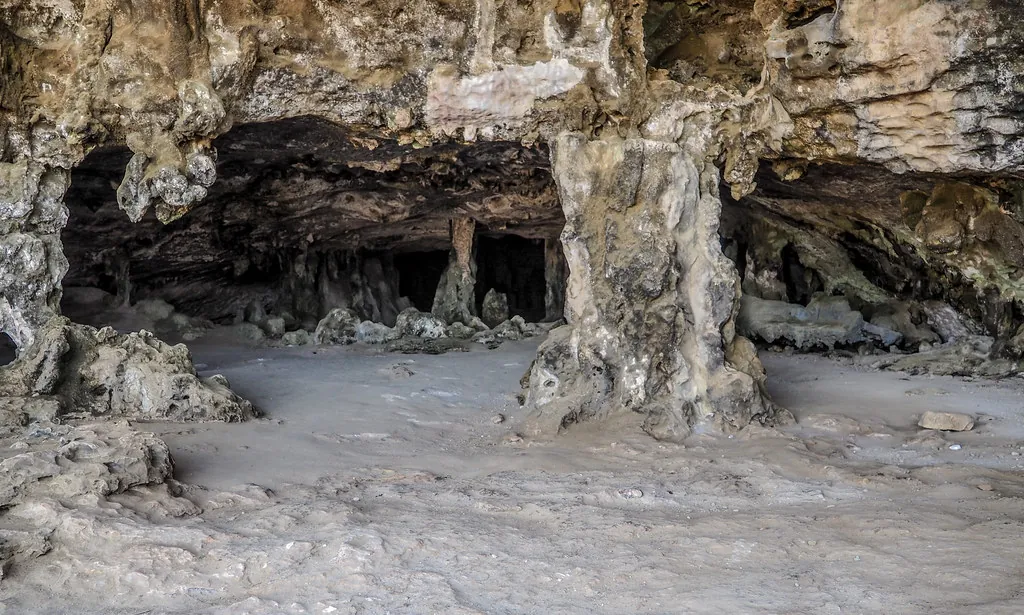
All Five Caves, Side by Side
Scan this before you book anything. The crowd column matters more than most guides let on, because two of these caves sit directly on the coach route and the rest do not.
| Cave | Drawings | Formations & light | Access difficulty | Crowd level | Best for |
|---|---|---|---|---|---|
| Fontein Cave (Arikok, near Santa Cruz) | Yes: Arawak (Caquetio) petroglyphs in white and black pigment, plus later historical marks | Smooth limestone, root casts, stalactites and stalagmites; the interior stays dark | Easy: flat sand floor, one low step, handrail at the mouth | Moderate to busy, heaviest between 10am and 2pm | Culture, rock art, short visits, mixed-age groups |
| Guadirikiri Cave (Arikok south) | None | Two chambers with daylight shafts punching through the roof, stalagmites, a resident bat colony | Easy to moderate: a few steps, dry floor | Busy at midday, calm after 3pm | Light beams, photography, watching bats |
| Quadirikiri Cave | None | Identical to Guadirikiri, because it is Guadirikiri under an older spelling | Identical | Identical | Nothing extra, and no reason to pay twice |
| Huliba Cave / Baranca Sunu (Arikok south) | None | A ninety-metre curved tunnel with a heart-shaped mouth and no daylight past the entrance | Harder: rough shadeless approach, torch and closed shoes essential, access often restricted | Low, and sometimes nil when bat protocols close it | A torch-lit squeeze and a bit of quiet |
| Tunnel of Love (as tour listings call it) | None | The same curved limestone passage, with that heart-shaped entrance everyone wants to photograph | Guided in practice; permissions and bat closures shift by season | Low to none | Chasing the arch shot at the mouth |
One thing worth knowing before you hand over any money: Guadirikiri and Quadirikiri are the same cave. Park signage leans one way, brochures lean the other, and I have watched a couple pay twice in a single afternoon for the privilege. Ask which coordinates you are being driven to, and ask what the drive time is.
Huliba’s access comes and goes. Bat health checks and rabies monitoring have closed the cave for long stretches in recent years, and Aruba Today usually carries the announcement when the situation changes. Ring the visitor centre on the morning of your visit rather than trusting a blog from 2019, mine included.
Fontein Cave: The One With the Arawak Drawings
Fontein Cave wins on a measure the other caves cannot touch. Just inside the entrance, where daylight still reaches the walls, the limestone carries Arawak petroglyphs: the Caquetio were the island’s Indigenous people when the first Spanish ships dropped anchor, and they painted and pecked these panels in white and black pigment. Spirals and geometric shapes, mostly, with a few marks nobody has convincingly explained to me in eight years of asking. The cave takes its name from the freshwater spring that seeps inside it (fontein is Dutch for fountain), and water in a dry landscape is the reason people sheltered here at all.
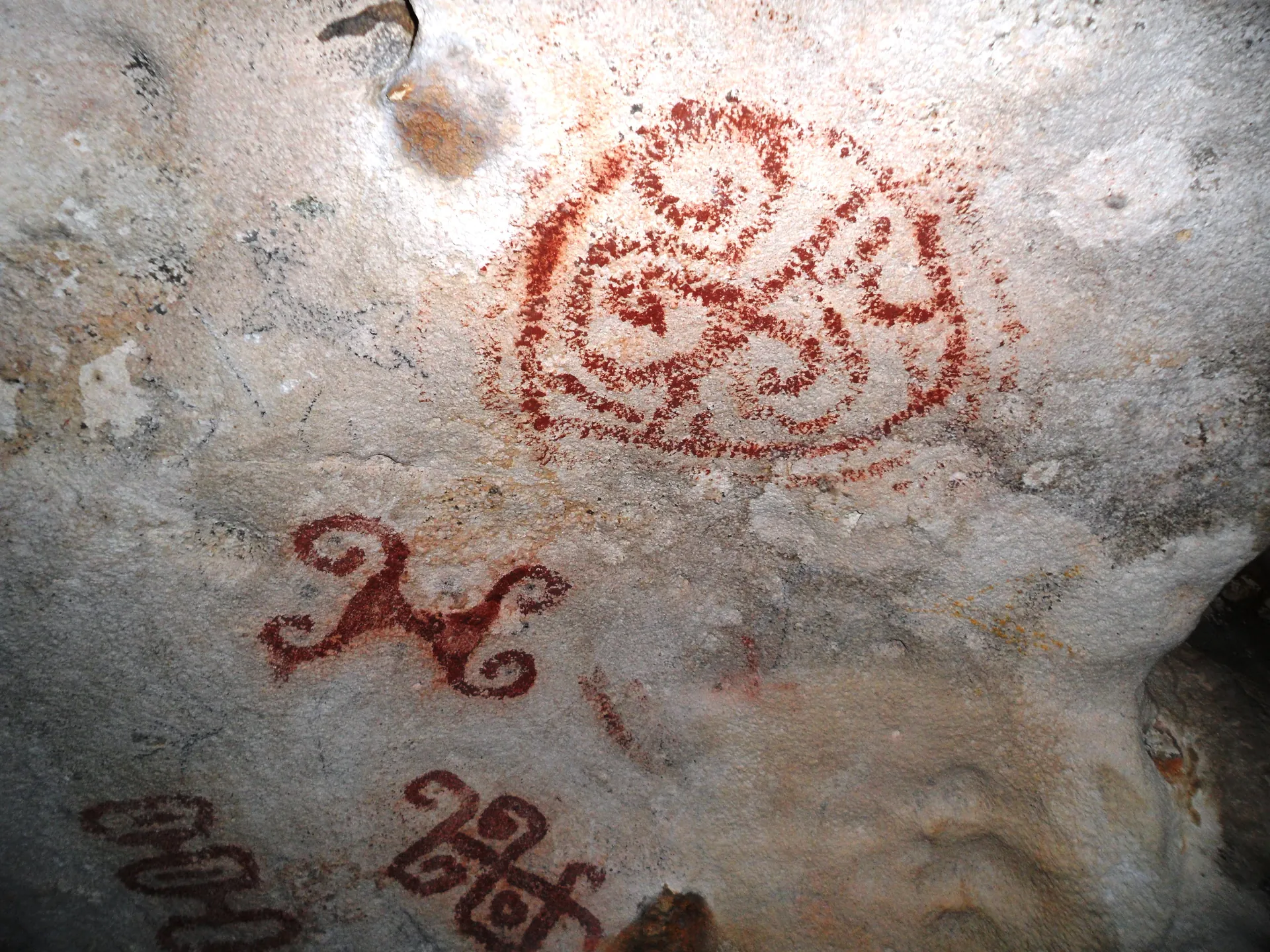
Stand close enough to read the pigment and the temperature drops another few degrees. The ceiling above the main panel is smooth as poured concrete, water having worked it over for millennia, while the stalactites further back hang like melted candles in an old cathedral. A pocket torch makes a real difference in here. Phone torches make a weaker one, and I say that as somebody who has tried both while sketching. My camera settings for the dark end of the cave live on the Fontein photos and formations page, if you want the numbers.
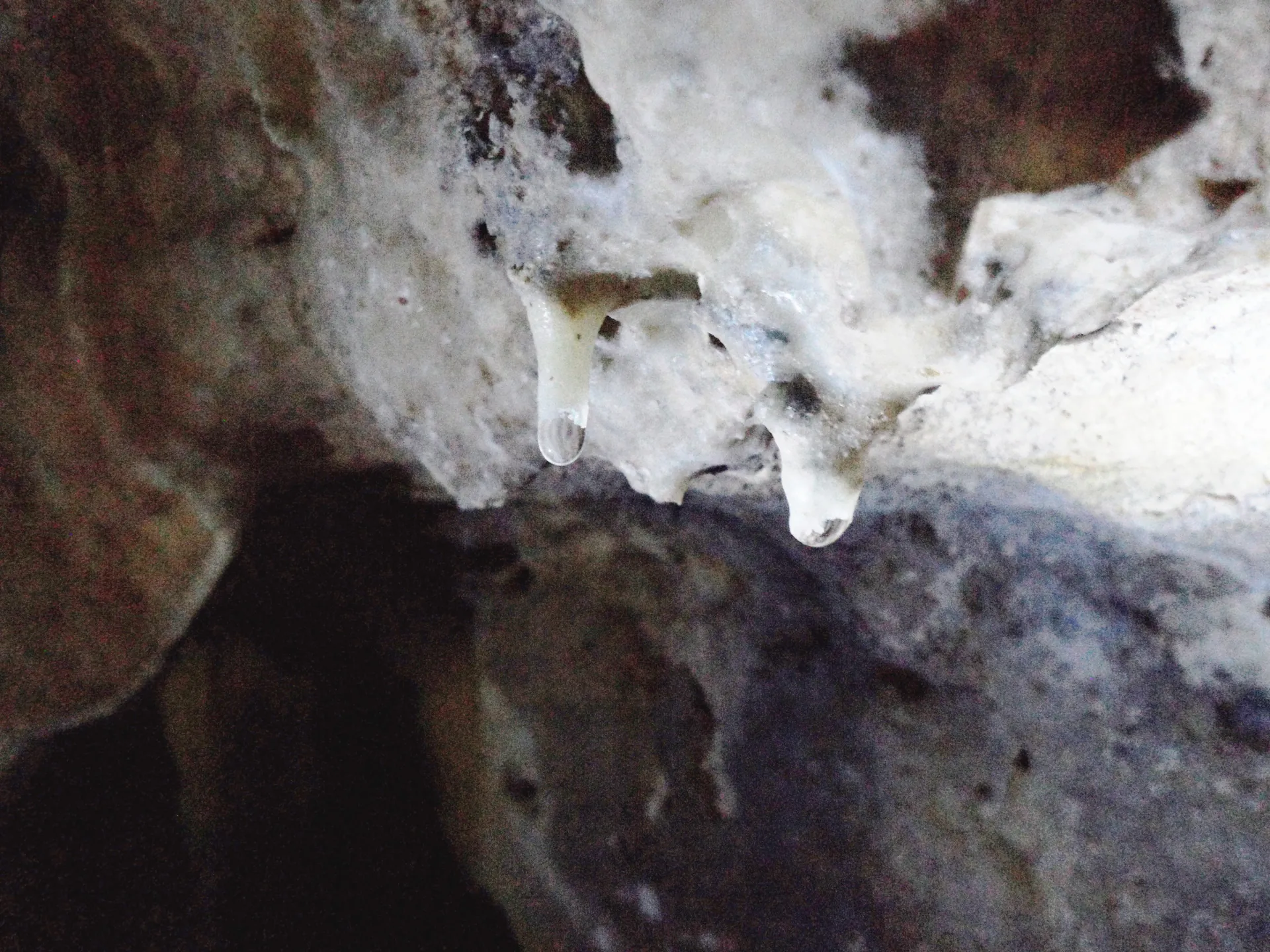
The cave itself is short, level and quick to walk, which is why families and cruise passengers often finish it in twenty minutes and why I usually linger for an hour. A park guide stands at the entrance most mornings handing out torches and helmets, and their reading of the drawings repays a rearranged schedule. Bats roost deeper in, so the no-touch rule is not a suggestion: fingers leave oil, oil kills pigment, and the drawings took several hundred years to get here. Flash is restricted in places, and the visitor rules page sets out exactly what you can and cannot do at the panels.
Arrive in the first hour after opening. The entrance light is softer then, the air is cooler, and you can stand in front of the drawings without somebody’s selfie stick crossing your line of sight.
For the archaeology, the pigment chemistry and the debate about what the spirals mean, the Fontein Cave history page goes far deeper than a comparison piece has room for.
Guadirikiri Cave: Two Chambers, Two Skylights
Guadirikiri is the largest of the set and the one most likely to be sold to you first, mainly because the coaches can park close. What you get inside: two chambers, two openings punched clean through the roof, and a shaft of light that lands on the sand around eleven in the morning. Tree roots dangle from the ceiling like rigging on an old ship, the air is musty and warm, and a shallow staircase takes you down into the second chamber without much drama.
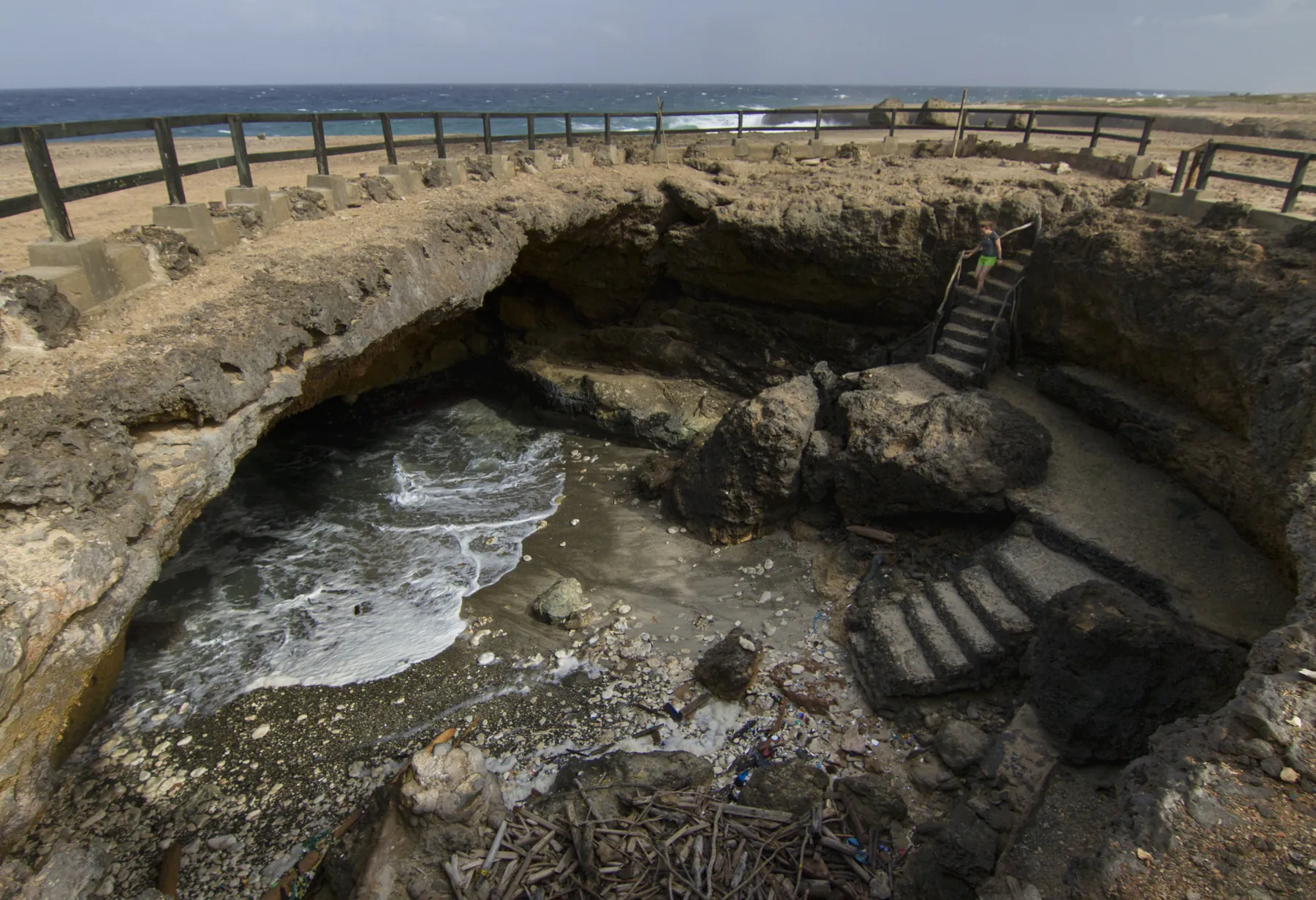
Long-nosed bats cluster in the darker crevices, which is either the best or the worst part of your day depending on your feelings about wings. They sleep through most of it, and the ones overhead are more interested in the ceiling than in you. Half an hour covers the visit if you keep moving; an hour covers it if you sit down and wait for the light to shift. Low-light settings and the best angles for the light shaft are on the photography page.
Quadirikiri: The Same Cave Under an Older Spelling
Quadirikiri turns up in listings as a separate, quieter cave with harder access, and that framing needs unpicking. The name is an alternative spelling of Guadirikiri, and most sources use the two interchangeably. What operators sometimes mean by the “harder, less visited” version is the upper or inner section reached by scrambling over loose rock, which is a different entrance rather than a different cave.
Use a simple decision rule. If a tour promises “Quadirikiri, the hidden one”, ask two questions before paying: which entrance, and how many steps. If the answer is vague, you are almost certainly being taken to the same skylit chambers as everybody else, at a premium price, with a nicer name attached. The tickets and tours page lists what each operator actually includes, which saves an awkward conversation at the trailhead.
Huliba Cave (Baranca Sunu) and the Tunnel of Love
Baranca Sunu means brown cliff in Papiamento, and the approach is exactly that: rough underfoot and longer than it looks on a map. Inside, a ninety-metre tunnel bends away from a heart-shaped entrance into proper blackness, and somewhere in the middle comes the crouch. The passage narrows to a hands-and-knees squeeze of roughly fifteen to twenty metres, which is where the helmets stop being theatre and start being sensible. Wooden ladders help in places, and none of it works in flip-flops.
Access is guided in practice, not because a ranger is counting heads at a turnstile but because permissions, bat protocols and seasonal closures decide whether the gate is open at all. Nobody with a fear of tight spaces should book it on a whim, and nobody should attempt it alone with a dying phone torch.
Clearing Up the Tunnel of Love
Some listings sell the Tunnel of Love as a standalone site near San Nicolas, complete with its own entrance fee. Inside Arikok, the name belongs to the squeeze within Huliba, the same passage that gets called Baranca Sunu on park signage. Confirm which one you have booked before the card comes out. It is a small thing, and it is the difference between a guided crawl and an afternoon sitting in a car park wondering where the cave went.
Four of Aruba’s famous caves will hand you formations and a bat story. Only Fontein hands you somebody’s handwriting from centuries before the first European ship arrived.
Accessibility and Mobility: The Honest Version
Cave floors are not pavements, and the humidity does strange things to glasses. This is the section most guides skip, so here it is without decoration.
- Fontein is the kindest of the five: a flat sand floor, one low step at the mouth, and daylight for the first stretch. Wheelchair users and slow walkers can reach the drawings with help, though the sand resists wheels.
- Guadirikiri needs a short descent and a climb back up. Manageable for most people, uncomfortable with a dodgy knee or a walking stick on loose grit.
- Huliba rules itself out for claustrophobia, pregnancy, recent surgery, toddlers and anyone unsteady on rough rock. The crawl is real, and turning around mid-passage takes nerve.
- Lintels and ceilings drop without warning once the daylight fades. A headtorch beats a phone every time, and a spare battery beats both.
- Bats overhead are harmless if you keep your distance and your voice down. Guano on the floor is slippery, so tread flat-footed.
- Footwear decides your day. Trainers with grip are fine for Fontein and Guadirikiri; Huliba wants something sturdier and closed.
- Water matters more than any gadget. The walk back to the car in the middle of the afternoon is hotter than the cave ever gets.
Nothing in Arikok has handrails where you would like them, and phone signal fades in the interior. Tell somebody where you are going, and carry more water than you think you need. The full etiquette list sits on the visitor rules page.
When the Buses Roll In
Crowding in Aruba’s caves follows the cruise calendar more closely than the seasons. On a three-ship day, the 10am to 2pm window turns Fontein and Guadirikiri into a slow-moving queue with commentary, and the light shaft in Guadirikiri collects a small crowd of tripods by half eleven. The first hour after opening is gold. Late afternoon is nearly as good, though the heat outside is at its worst and the light inside is dropping.
High season runs roughly from December into April, when the island fills up and the caves fill with it. Autumn is quieter, greener and wetter, and the park sometimes closes dirt tracks after heavy rain until they dry. If a wet night has passed, check the park status page before committing a hire car to the interior.
Guided or Self-Driving: Which You Actually Need
- Vehicle: Tarmac takes you to the Arikok main entrance and all the way down to San Nicolas without drama. Everything inside the park boundary is dirt and loose rock, and ordinary hire cars are not insured for it. A small 4×4, a park guide’s truck or your own two feet are the sensible options.
- Park entry: Arikok charges per person, roughly €10 to €14 (about $11 to $15) per adult, with a separate charge per private vehicle. Rates sit under the Government of Aruba protected-areas framework and are published by the park foundation; I keep the current numbers on my Arikok fees and entry tips page. Keep the receipt on the dashboard.
- Heat: Between 11am and 3pm the interior is not somewhere you want to be standing about. Water, a hat and closed shoes decide whether the morning goes well or badly.
- Tours: If you are in port for a single day, a guided cave run removes the driving and the timing stress in one go. Half-day jeep safaris with cave stops typically run €70 to €130 (~$78 to $140) per person and bundle park entry. Options and prices sit on the tickets page.
- Accessibility: Everything on the paved circuit is manageable in a normal car, and Fontein is the most level of the five. Guadirikiri needs a short climb. Huliba is not suitable for wheelchairs or for anyone unsteady on loose rock.
A Cave Day That Actually Works
- Leave the hotel strip by 7:30. Traffic through Santa Cruz is light before eight and the park gate is quieter.
- Fontein first, while the entrance is still in shade and the drawings read without squinting.
- Guadirikiri next, timed for the late-morning light shaft. Allow forty minutes, more if the bats are active.
- Lunch in San Nicolas or back near Santa Cruz, then decide on Huliba. If bats or heat have closed it, take the murals in town instead.
- Finish at Baby Beach or Spanish Lagoon with a swim, which is the correct way to end any cave day.
Two corrections to things you will read elsewhere. The natural cave pool inside the park has been shut for years on safety and conservation grounds, and it has not reopened, so do not build a day around swimming underground. Older blogs still promise it, and the cave pool closure page explains the story properly. And Fontein does not need a separate ticket: one park entry covers it, the drawings included.
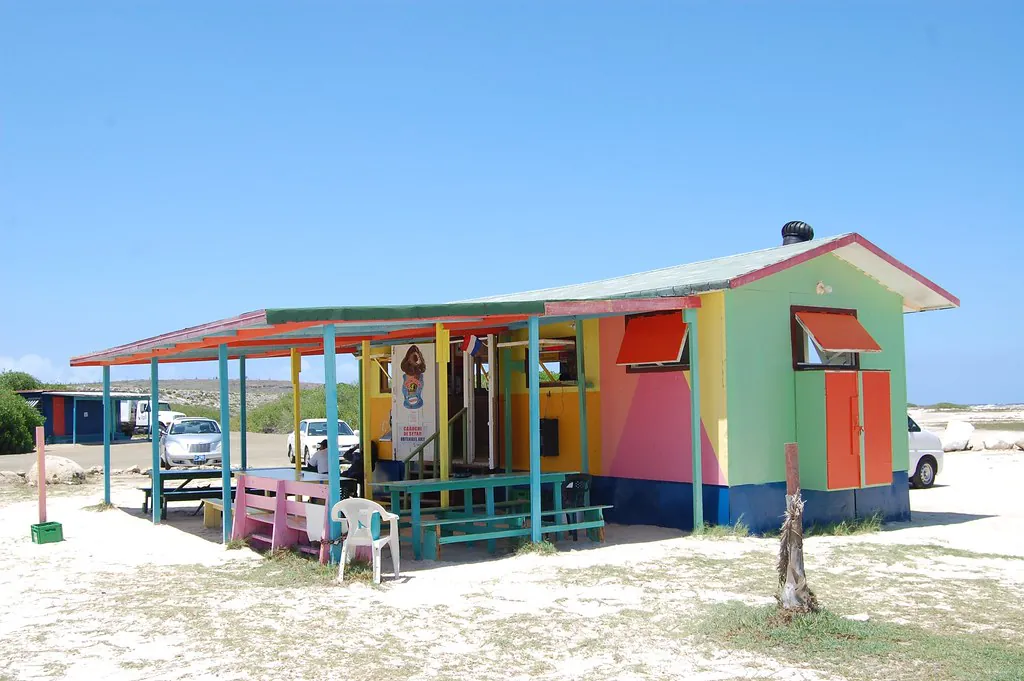
Food belongs in the plan, not tacked on afterwards. San Nicolas does pastechi (fried pastry with cheese or meat), keshi yena and grilled fish, Baby Beach has its shacks, and roadside stalls upcountry sell mango, papaya and tamarind in season, along with the local aloe products everyone leaves with. Tipping follows the American habit here: fifteen to twenty per cent at restaurants, a dollar or two per drink at a bar, and a few dollars for the cave guide who lent you a torch and knew the drawings by heart.
Getting there is straightforward once you know which gate suits you: the main entrance sits off the Santa Cruz road, the San Nicolas side suits the southern cluster. Distances, drive times and signage quirks are on the transport guide and the map page, which together cover more than this comparison needs to.
Pick Your Cave, Then Pick Your Day
Fontein holds the drawings and the cultural weight. Guadirikiri holds the light. Huliba holds the dark and the squeeze. San Nicolas holds the murals, the murals and the food, which counts for a great deal by mid-afternoon. Build the day around what your body will thank you for, and leave room for the one thing no itinerary accounts for: standing still in a limestone chamber while water finds its way down.